

Study Overview
Proteome analysis is the large-scale study of the proteome—the entire set of proteins expressed by a cell, tissue, or organism—to understand cellular pathways, biological processes, and disease mechanisms. Olink’s Proximity Extension Assay (PEA) technology is a high-throughput, multiplex protein biomarker detection method. It combines antibody-based immunoassays with DNA-based amplification (qPCR or Next-Generation Sequencing). This dual-recognition mechanism ensures high specificity and sensitivity from low sample volumes.
Since the PEA technology relies on PCR as part of the workflow, we are able to offer two methods for sequencing: Next generation sequencer (NovaSeq 600 system) and a real-time PCR (RT-PCR) instrument (Signature Q100). Next generation sequencing allow for higher throughput, but is significantly more expensive than RT-PCR. Absolute quantification is also possible for RT-PCR analysis. Please consult us for more information
We are able to work with a large range of biological samples, including serum and plasma.
Characteristics of quantification by PEA
“PEA (Proximity Extension Assay)” is a method that uses an oligonucleotide-labeled antibody pair against a target protein.

The two antibodies bind to the same target in close proximity, allowing the oligos to hybridize.

From there, the DNA is extended and read using real-time PCR or NGS (next generation sequencing).
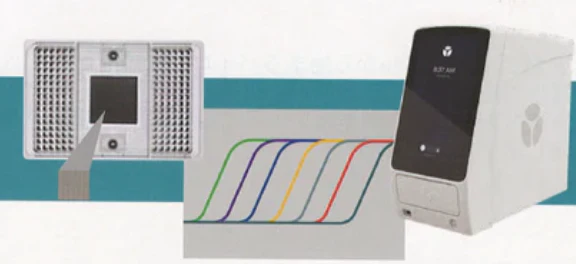
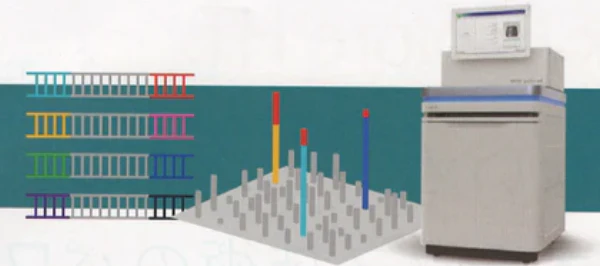
This allows for the simultaneous, highly sensitive measurement of multiple proteins using very small sample volumes (approximately 1–6 µL).
Its major strength is its high specificity and quantification.
Experimental design options
There are a few experimental plans available:
| Plan | Key Features |
| Olink Explore HT | It targets over 5,400 types of proteins. It boasts a wide dynamic range and high specificity (99.5%). The sample volume is 2 µL. Analysis is performed using a next-generation sequencer (NovaSeq 600 system). |
| Olink Reveal | Protein panels containing 43 to 92 proteins. Sample volume: 1 µL. Supports both absolute and relative quantification. Rigorously validated. Analysis is performed using a dedicated real-time PCR instrument (Signature Q100). |
| Olink Target 96 / Target 48 | Can measure 43 to 92 proteins in a single test. Only 1 µL of sample is required. It can measure the actual amount of proteins and also compare differences between samples. The test method has been carefully checked to provide reliable results. |
| Olink Flex & Focus | A small-scale panel consisting of 15 to 21 targets. Sample volume is 1 µL. Supports both absolute and relative quantification. Rigorously validated. Analysis is performed using a dedicated real-time PCR instrument (Signature Q100). |
Application to cell-based assay
Olink analysis is also available for cell-based assays.
Proteome analysis is possible by analyzing cell culture supernatants using Olink’s PEA technology.
Please feel free to contact us.
*All our studies are mainly performed and handled by our team of PhD scientists.