

Study Overview
IgA is an antibody found in mucous membranes that neutralizes pathogens and viruses like influenza to prevent infection. It is primarily produced in the intestinal Peyer’s patches, where B cells transform into IgA-producing cells (class-switching) before migrating to regions of the body that contain mucous membranes such as the mouth and nose. Because IgA provides a first line of defense, substances that boost its production may help prevent various infectious diseases.
This study evaluates the ability of a test substance to promote IgA production in Peyer’s patch cells. In addition to IgA production, our proprietary test system allows us to measure not only B cell proliferation, but also IgA class switching. These cellular process are key indicators of IgA production, and allow us to identify food ingredients and immune adjuvants that affect IgA production. The effects of B cell proliferation factors (such as LPS or Poly (I:C) double stranded RNA) can also be analyzed in this system.
Study example
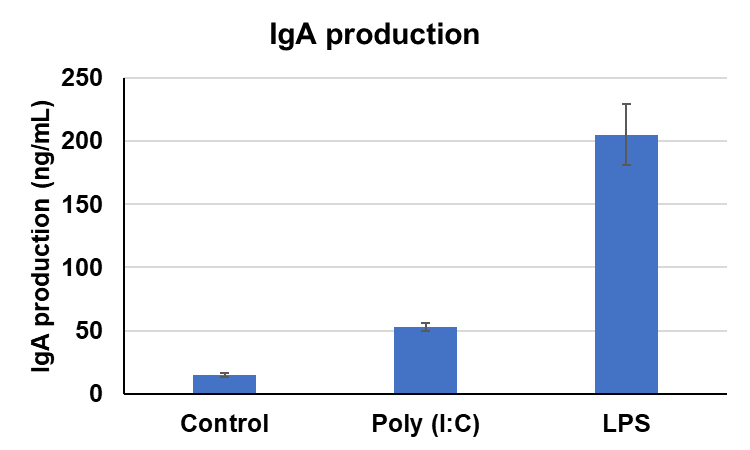
Basic Experimental design
| Cells used | Mouse intestinal Peyer’s patch cells |
|---|---|
| Measurement items | IgA production (measured by ELISA) |
*All our studies are mainly performed and handled by our team of PhD scientists.