

Study Overview
Recombinant proteins are artificially engineered biomolecules produced by inserting a specific gene or DNA sequence into a host organism. The host cell’s cellular machinery is then used to express, synthesize, and translate the protein of interest. Recombinant proteins are widely utilized as vital tools across biomedical research, disease diagnostics, and clinical therapeutics, serving as growth factors, cytokines, enzymes, and therapeutic medications like insulin and vaccines. We are able to evaluate recombinant proteins using appropriate cells and experimental systems using various tests. These tests verify the novel effects and activity of recombinant proteins, as well as the quality of the recombinant protein.
Study example
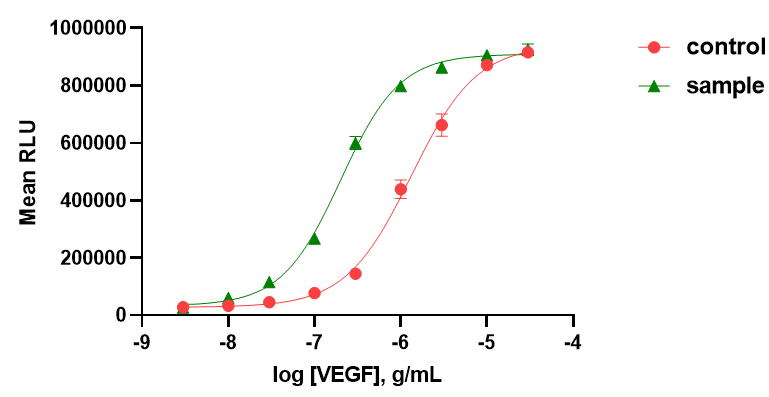
VEGF cell proliferation assay using HUVEC
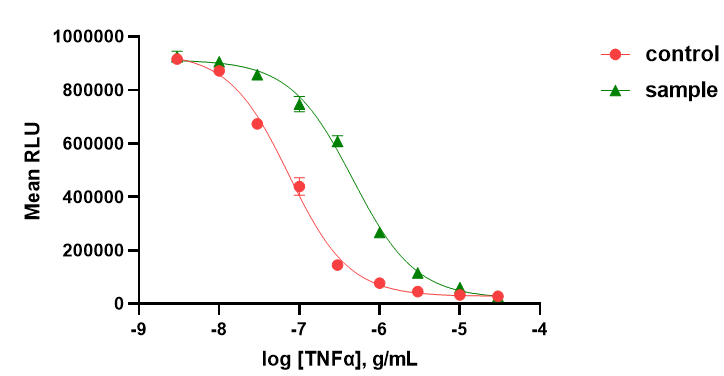
Cytotoxicity test of TNFα using mouse fibroblast L929 cells
List of studies conducted (excerpt)
| Evaluation protein | Evaluation method |
| BMP-2, BMP-4, BMP-7, Noggin | ALP (alkaline phosphatase) activity assessment |
| bFGF, EGF, PDGF, TGF-α | Cell proliferation assessment |
| BDNF, Flt3 ligand, Leptin | Cell proliferation assessment |
| Shh | ALP (alkaline phosphatase) activity assessment |
| Various Interferons, Interleukins, Wnts, etc. | Various reporter assays |
| VEGF | Cell proliferation assessment |
| TNF-α | Cell proliferation assessment |
| IGF-1 | Cell proliferation assessment |
| RANKL | TRAP (tartrate-resistant activated phosphatase) activity assessment |
| IL-4, IL-5, IL-13, GM-CSF, NGF, Oncostatin M, SCF, CNTF, EPO, LIF | Cell proliferation assessment |
| RANKL | TRAP (tartrate-resistant activated phosphatase) activity assessment |
*We can also evaluate proteins other than those listed above.
**We also accept custom-order studies incorporating your desired evaluation method.
*All our studies are mainly performed and handled by our team of PhD scientists.